
Website of George Pashev (Jidai Mirai)
Scientist, Programmer, Data Scientist, Entrepreneur
Simple Crawler
Робот, търсещ по шаблон текст в уеб страници. Поддържа се откриване на абсолютни адреси към други страници в кода на текущата страница. При евентуално открити нови адреси, те се добавят в списък на предстоящо посещение, който се състои от 2 основни компонента: Компоненти на списъка за предстоящо посещение Опашка за предстоящо посещение, която се използва за определяне на текущата страница, която да бъде посетена Хеш таблица, реализираща бързо търсене в списъка за предстоящо посещение. Поддържа функционалност – запаметяване на тези адреси във файлове, като при евентуално следващо стартиране на програмата с тези настройки, тя не добавя тези адреси наново в списъка за предстоящо посещение. Особености на шаблона за търсене Шаблона за търсене може да съдържа символа * (звезда), който се интерпретира от алгоритъма за търсене, като какъвто и да е текст. Например шаблонът “ *@*.* “ допуска откриването на запис “ georgipashev@mail.bg ”. Поддържат се и частните случаи – търсене на точно съвпадение (без *) и сканиране на целия текст (само със *) Използвана среда за програмиране: Microsoft Visual C++ 9.0 Express Edition
симулатор на проста микропроцесорна архитектура
ТУ – София
Филиал Пловдив
КУРСОВ ПРОЕКТ
Тема:
Създаване на симулатор на проста микропроцесорна архитектура
На Георги Петров Пашев
Гр. 41, Специалност: КСТ
1. Задание
Да се създаде симулатор на система инструкции на микропроцесорна архитектура. За опростяване, приема се, че няма конвейерна обработка на инструкциите. Трябва да се спазва брой цикли, необходими за изпълнението на всяка една инструкция. След изпълнението на всяка инструкция, симулаторът трябва да може да показва състоянието на регистрите, под формата на двоично или шестнадесетично представяне на съдържанието им, както и колко цикли са изминали от началото на програмата до тук. Симулаторът трябва да приема за вход текстови файлове с програми, написани на асемблерен език, дефиниран по-долу.
Микропроцесорът, трябва да има следният програмен модел:
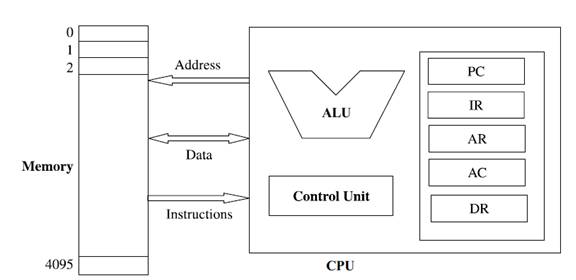
Регистрите са както следва:
PC – програмен брояч, IR-регистър за инструкции, AR- адресен регистър, AC- акумулатор, DR – даннов регистър
Приема се, че размерът на всяка една инструкция е 16 бита. От тях 4 бита се използват за код на операцията, а останалите 12 – за операнд, който ще е адрес. Това определя размера на адресното пространство да бъде 4 к. Приема се, че програматорът зарежда програмата за изпълнение в паметта от адрес 0х0. Размерът на думата е 16 бита.
Валидните инструкции, които трябва да поддържа микропроцесорът са следните:
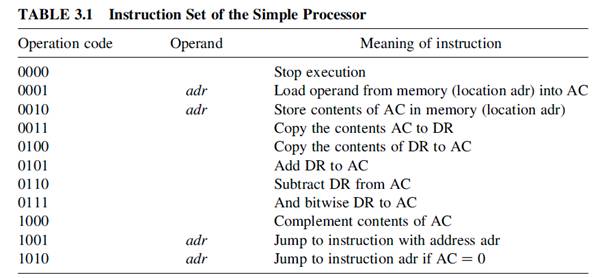
Оставям на студента да избере подходящ мнемоничен код за всяка една от инструкциите, както и да определи колко цикли са необходими за изпълнението и. Да се напише примерен асемблерен код.
2. Реализация
a. Определяне на мнемоничния код на инструкциите и формата на операндите
|
КОП |
Мнемоничен код |
Пример за използване на инструкцията |
Необходими цикли |
|
0000 |
HALT |
HALT |
1 |
|
0001 |
LD |
LD 0x345 |
2 |
|
0010 |
ST |
ST 0x346 |
2 |
|
0011 |
CAD |
CAD |
1 |
|
0100 |
CDA |
CDA |
1 |
|
0101 |
ADA |
ADA |
1 |
|
0110 |
DMA (DR Minus AC) Result stays in AC |
DMA |
1 |
|
0111 |
DAA (DR Bitwise And AC) Result stays in AC |
DAA |
1 |
|
1000 |
NA (Not AC) |
NA |
1 |
|
1001 |
JMP |
JMP 0x30f |
1 |
|
1010 |
JAZ (Jump if AC==0) |
JAZ 0x305 |
1 |
b. Реализация на програмата симулатор
За реализацията на програмата симулатор се използваt Microsoft .NET класове в C++, като продукта от линкване е смесен тип (Native и Managed код), което осигурява по-бързото изпълнение на определени части от програмния код, които са Native, отколкото ако се използваше изцяло .NET Managed код, което е предимство, достъпно само за езика C++.
Функционалността на симулатора може да се раздели на 2 основни части: компилатор и дебъгер.
Компилаторът превежда асемблерният език на машинен, като резултатът се пази в масива prog[], като най младшият байт на всеки четерибайтов елемент в масива съдържа КОП (старша тетрада) и най-старшата тетрада на операнда, ако има такава. Вторият байт съдържа младшите тетради на операнда, ако има такъв. Другите 2 байта не се използват. Понеже адресното пространство се състои от 4096 думи, адресът не трябва да е по-голям от 4095 или 0xfff.
Компилаторът взема нов ред от файл, избран от потребителя и премахва символът за нов ред от него. След това открива последователността за коментар ‘//’ и ако открие такава, замества първия символ ‘/’ с 0, което откъсва всичко след нулевия символ от стринга. След това замества всички малки букви с големи, за да се осигури независимост от малки или големи букви и премахва всички интервали от дясната страна на инструкцията.
След прилагането на горните трансформации върху стринга, той се подава на алгоритъм за намиране на текст по шаблон, като последователно се търсят шаблонни съвпадения за всички инструкции. При намиране на такова съвпадение, това съвпадение се подава на специфичната callback функция за конкретната инструкция, която проверява за валидност на операнд, ако има такъв и евентуално връща съобщение за грешка, а освен това попълва текущия елемент в масива prog[] с валидния код на инструкцията.
Ако не се намери дори и 1 шаблонно съвпадение, това означава, че може да имаме частен случай: празен ред, имащ само интервали. След прилагане на трансформациите, той се преобразува в стринг с нулева дължина. Това означава, че ако дължината на стринга е положителна имаме грешка в кода и това условие се използва за откриването и.
При наличие на поне 1 грешка, компилацията се прекратява, извежда се съобщение за грешка и масива prog[], както и управляващи глобални променливи се преинициализират.
Дебъгера показва състоянието на регистрите след изпълнението на инструкциите, както и колко цикли четене/запис от и в паметта са настъпили сумарно от началото на изпълнението на програмата.
При изпълнението на примерната програма:
LD 0x6
CAD
LD 0x7
ADA
HALT
Което поредставлява програма, която събира 2 думи, намиращи се на адреси 6 и 7 и запазва резултата в AC, изхода след изпълнението на последната инструкция е следния:
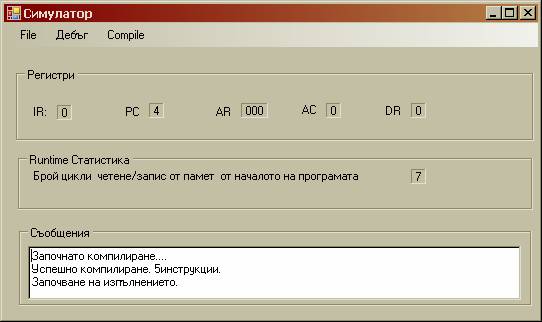
А изхода в полето съобщения е следния:
Започнато компилиране....
Успешно компилиране. 5инструкции.
Започване на изпълнението.
Достингата инструкция LD, зареждане на операнд в AC.
Достингата инструкция CAD, копираме AC в DR.
Достингата инструкция LD, зареждане на операнд в AC.
Достингата инструкция ADA, AC=AC+DR.
Достингата инструкция HALT, спиране на изпълнението.
В системата инструкции няма такива, които работят с константи, затова примера показва 0 като резултат, защото на адреси 6 и 7, първоначалните инициализации са с 0.
Следват дефинициите на по-важните методи и членове на класове, както и други променливи и функции в програмата:
#pragma once
namespace processor_sim {
using namespace System;
using namespace System::ComponentModel;
using namespace System::Collections;
using namespace System::Windows::Forms;
using namespace System::Data;
using namespace System::Drawing;
using namespace System::Text;
using namespace System::IO;
using namespace System::Net;
using namespace System::Net::Sockets;
using namespace System::Collections;
using namespace System::Threading;
static FILE *fp_asm;
static FILE *fp_bin;
//регистри
static int PC_reg, IR_reg, AR_reg, AC_reg, DR_reg;
//брояч на циклите
static int cycles_reg;
//копие на двоичната програма
int prog[4096];
//реда до който компилатора е стигнал
static int line_nr;
public ref class Form1 : public System::Windows::Forms::Form
{
public:
Form1(void)
{
InitializeComponent();
//
//TODO: Add the constructor code here
//
cur_asm_fname=gcnew String("");
cur_bin_fname=gcnew String("");
fp_asm=0;
fp_bin=0;
PC_reg=0;
IR_reg=0;
AR_reg=0;
AC_reg=0;
DR_reg=0;
int i;
for(i=0; i<4096; i++)
prog[i]=0;
line_nr=0;
cycles_reg=0;
timer1->Interval=1000;
timer1->Stop();
}
protected:
/// <summary>
/// Clean up any resources being used.
/// </summary>
~Form1()
{
if (components)
{
delete components;
}
if(cur_asm_fname)
delete cur_asm_fname;
if(cur_bin_fname)
delete cur_bin_fname;
if(fp_asm)
fclose(fp_asm);
if(fp_bin)
fclose(fp_bin);
}
private: System::Windows::Forms::GroupBox^ groupBox1;
public: System::Windows::Forms::Label^ IR;
private:
protected:
private: System::Windows::Forms::Label^ label1;
private: System::Windows::Forms::Label^ label4;
public: System::Windows::Forms::Label^ AR;
private:
private: System::Windows::Forms::Label^ label3;
public: System::Windows::Forms::Label^ PC;
private:
private: System::Windows::Forms::Label^ label2;
public: System::Windows::Forms::Label^ DR;
private:
private: System::Windows::Forms::Label^ label5;
public: System::Windows::Forms::Label^ AC;
private:
private: System::Windows::Forms::MenuStrip^ menuStrip1;
private: System::Windows::Forms::ToolStripMenuItem^ fileToolStripMenuItem;
private: System::Windows::Forms::ToolStripMenuItem^ отвориToolStripMenuItem;
private: System::Windows::Forms::ToolStripMenuItem^ aSMFileToolStripMenuItem;
private: System::Windows::Forms::ToolStripMenuItem^ bINFileToolStripMenuItem;
private: System::Windows::Forms::ToolStripMenuItem^ запазиКатоToolStripMenuItem;
private: System::Windows::Forms::ToolStripMenuItem^ bINFileToolStripMenuItem1;
private: System::Windows::Forms::ToolStripMenuItem^ изходToolStripMenuItem;
private: System::Windows::Forms::ToolStripMenuItem^ дебъгToolStripMenuItem;
private: System::Windows::Forms::ToolStripMenuItem^ стартToolStripMenuItem;
private: System::Windows::Forms::ToolStripMenuItem^ паузаToolStripMenuItem;
private: System::Windows::Forms::GroupBox^ groupBox2;
private: System::Windows::Forms::Label^ cycles;
private: System::Windows::Forms::Label^ label6;
private: System::Windows::Forms::OpenFileDialog^ ofd;
private: System::Windows::Forms::SaveFileDialog^ sfd;
private: System::Windows::Forms::GroupBox^ groupBox3;
private: System::Windows::Forms::TextBox^ messages;
String^ cur_asm_fname;
String^ cur_bin_fname;
private: System::Windows::Forms::ToolStripMenuItem^ компиToolStripMenuItem;
private: System::Windows::Forms::ToolStripMenuItem^ compileToolStripMenuItem;
public: System::Windows::Forms::Timer^ timer1;
private:
public:
private: System::ComponentModel::IContainer^ components;
//public: delegate void func_del(char *);
private:
/// <summary>
/// Required designer variable.
/// </summary>
#pragma region Windows Form Designer generated code
/// <summary>
/// Required method for Designer support - do not modify
/// the contents of this method with the code editor.
/// </summary>
void InitializeComponent(void)
{
//няколко страници инициализации, които не са интересни
}
#pragma endregion
private: System::Void Form1_Load(System::Object^ sender, System::EventArgs^ e) {
}
private: System::Void aSMFileToolStripMenuItem_Click(System::Object^ sender, System::EventArgs^ e) {
ofd->InitialDirectory = "c:\\";
//Stream^ myStream;
FILE *fp;
ofd->Filter = "ASM files (*.asm)|*.txt|All files (*.*)|*.*";
ofd->FilterIndex = 2;
ofd->RestoreDirectory = true;
if ( ofd->ShowDialog() == System::Windows::Forms::DialogResult::OK )
{
try{
char *fname=new char[612];
ConvertStrToChar(fname, ofd->FileName);
fp_asm=fopen(fname, "r");
delete fname;
}catch(System::Exception ^e){
MessageBox::Show(L"Не мога да отворя файл.", L"Грешка", MessageBoxButtons::OK, MessageBoxIcon::Error);
}
}
}
private: System::Void изходToolStripMenuItem_Click(System::Object^ sender, System::EventArgs^ e) {
Application::Exit();
}
private: System::Void compileToolStripMenuItem_Click(System::Object^ sender, System::EventArgs^ e) {
//тука се пише кода за компилирането
if(!(fp_asm)){
ShowError("Няма отворен ASM file.");
return;
}
this->messages->Text=messages->Text+gcnew String("Започнато компилиране.... \r\n");
//буфер, в който се държи 1 прочетен ред от асм файла
char * fbuf=new char[512];
int i;
fbuf[0]=0;
while(1){
//fflush(fp_asm);
//if(fscanf(fp_asm, "%s\r\n", fbuf)<=0)
// break;
if(!fgets(fbuf, 512, fp_asm))
break;
if(fbuf[strlen(fbuf)-1]==32)
fbuf[strlen(fbuf)-1]=0;
//откриване и изолиране на коментар в кода
for(i=0; i<strlen(fbuf)-1; i++)
if(fbuf[i]=='/'&&fbuf[i+1]=='/'){
fbuf[i]=0;
}
to_upper(fbuf);
remove_intervals(fbuf);
if(line_nr>4095)
{
ShowError("Кодът е по-голям отколкото адресното пространство може да побере.");
for(i=0; i<4096; i++)
prog[i]=0;
line_nr=0;
return;
}
func_del^ del=gcnew func_del(this, &processor_sim::Form1::halt_func);
if(findocccurencesnew("HALT", fbuf, del )>0)
continue;
del=gcnew func_del(this, &processor_sim::Form1::cad_func);
if(findocccurencesnew("CAD", fbuf, del )>0)
continue;
del=gcnew func_del(this, &processor_sim::Form1::cda_func);
if(findocccurencesnew("CDA", fbuf, del )>0)
continue;
del=gcnew func_del(this, &processor_sim::Form1::ada_func);
if(findocccurencesnew("ADA", fbuf, del )>0)
continue;
del=gcnew func_del(this, &processor_sim::Form1::dma_func);
if(findocccurencesnew("DMA", fbuf, del )>0)
continue;
del=gcnew func_del(this, &processor_sim::Form1::daa_func);
if(findocccurencesnew("DAA", fbuf, del )>0)
continue;
del=gcnew func_del(this, &processor_sim::Form1::na_func);
if(findocccurencesnew("NA", fbuf, del )>0)
continue;
del=gcnew func_del(this, &processor_sim::Form1::ld_func);
if(findocccurencesnew("LD *", fbuf, del )>0)
continue;
del=gcnew func_del(this, &processor_sim::Form1::st_func);
if(findocccurencesnew("ST *", fbuf, del )>0)
continue;
del=gcnew func_del(this, &processor_sim::Form1::jmp_func);
if(findocccurencesnew("JMP *", fbuf, del )>0)
continue;
del=gcnew func_del(this, &processor_sim::Form1::jaz_func);
if(findocccurencesnew("JAZ *", fbuf, del )>0)
continue;
if(strlen(fbuf)>1){
messages->Text+="Грешка: На ред "+Int32(line_nr)+" командата не отговаря на нито един от шаблоните. \r\n"+Int32(strlen(fbuf))+gcnew String(fbuf)+"\r\n";
for(i=0; i<4096; i++)
prog[i]=0;
line_nr=0;
return;
}
}
if(line_nr>=0)
messages->Text+="Успешно компилиране. "+Int32(line_nr)+ "инструкции.\r\n";
delete fbuf;
}
void halt_func(char *arg){
int i=0, j;
for(i=4; i<strlen(arg); i++)
if(arg[i]!=' ')
{
this->messages->Text+="Грешка: Невалиден символ намерен на ред "+(gcnew Int32(line_nr))+" след HALT \r\n";
for(j=0; j<=line_nr; j++)
prog[j]=0;
line_nr=0;
return;
}
char *a=(char *)&prog[line_nr];
//кода на операцията
*a=0x0<<4;
line_nr++;
}
void cad_func(char *arg){
int i=0, j;
for(i=3; i<strlen(arg); i++)
if(arg[i]!=' ')
{
this->messages->Text+="Грешка: Невалиден символ намерен на ред "+(gcnew Int32(line_nr))+" след CAD \r\n";
for(j=0; j<=line_nr; j++)
prog[j]=0;
line_nr=0;
return;
}
char *a=(char *)&prog[line_nr];
//кода на операцията
*a=0x3<<4;
line_nr++;
}
void cda_func(char *arg){
int i=0, j;
for(i=3; i<strlen(arg); i++)
if(arg[i]!=' ')
{
this->messages->Text+="Грешка: Невалиден символ намерен на ред "+(gcnew Int32(line_nr))+" след CDA \r\n";
for(j=0; j<=line_nr; j++)
prog[j]=0;
line_nr=0;
return;
}
char *a=(char *)&prog[line_nr];
//кода на операцията
*a=0x4<<4;
line_nr++;
}
void ada_func(char *arg){
int i=0, j;
for(i=3; i<strlen(arg); i++)
if(arg[i]!=' ')
{
this->messages->Text+="Грешка: Невалиден символ намерен на ред "+(gcnew Int32(line_nr))+" след ADA \r\n";
for(j=0; j<=line_nr; j++)
prog[j]=0;
line_nr=0;
return;
}
char *a=(char *)&prog[line_nr];
//кода на операцията
*a=0x5<<4;
line_nr++;
}
void dma_func(char *arg){
int i=0, j;
for(i=3; i<strlen(arg); i++)
if(arg[i]!=' ')
{
this->messages->Text+="Грешка: Невалиден символ намерен на ред "+(gcnew Int32(line_nr))+" след DMA \r\n";
for(j=0; j<=line_nr; j++)
prog[j]=0;
line_nr=0;
return;
}
char *a=(char *)&prog[line_nr];
//кода на операцията
*a=0x6<<4;
line_nr++;
}
void daa_func(char *arg){
int i=0, j;
for(i=3; i<strlen(arg); i++)
if(arg[i]!=' ')
{
this->messages->Text+="Грешка: Невалиден символ намерен на ред "+(gcnew Int32(line_nr))+" след DAA \r\n";
for(j=0; j<=line_nr; j++)
prog[j]=0;
line_nr=0;
return;
}
char *a=(char *)&prog[line_nr];
//кода на операцията
*a=0x7<<4;
line_nr++;
}
void na_func(char *arg){
int i=0, j;
for(i=2; i<strlen(arg); i++)
if(arg[i]!=' ')
{
this->messages->Text+="Грешка: Невалиден символ намерен на ред "+(gcnew Int32(line_nr))+" след NA \r\n";
for(j=0; j<=line_nr; j++)
prog[j]=0;
line_nr=0;
return;
}
char *a=(char *)&prog[line_nr];
//кода на операцията
*a=0x8<<4;
line_nr++;
}
void ld_func(char *arg){
int i=0, j;
int k;
try{
sscanf(arg, "LD 0X%X", &k);
}catch(Exception^ e){
this->messages->Text+="Грешка: Невалиден символ намерен на ред "+(gcnew Int32(line_nr))+" след команда LD \r\n";
for(j=0; j<=line_nr; j++)
prog[j]=0;
line_nr=0;
return;
}
char *a=(char *)&prog[line_nr];
//кода на операцията
*a=0x1<<4;
if(k>4095||k<0)
{
this->messages->Text+="Грешка на ред "+(gcnew Int32(line_nr))+" след команда LD: невалиден размер на адрес \r\n";
for(j=0; j<=line_nr; j++)
prog[j]=0;
line_nr=0;
return;
}
else if(k>255)
{
(*a)^=(char)((k&0xf00)>>8);
}else
*(a+1)=(char)(k&0xff);
line_nr++;
}
void st_func(char *arg){
int i=0, j;
int k;
try{
sscanf(arg, "ST 0X%X", &k);
}catch(Exception^ e){
this->messages->Text+="Грешка: Невалиден символ намерен на ред "+(gcnew Int32(line_nr))+" след команда ST \r\n";
for(j=0; j<=line_nr; j++)
prog[j]=0;
line_nr=0;
return;
}
char *a=(char *)&prog[line_nr];
//кода на операцията
*a=0x2<<4;
if(k>4095||k<0)
{
this->messages->Text+="Грешка на ред "+(gcnew Int32(line_nr))+" след команда ST: невалиден размер на адрес \r\n";
for(j=0; j<=line_nr; j++)
prog[j]=0;
line_nr=0;
return;
}
else if(k>255)
{
(*a)^=(char)((k&0xf00)>>8);
}else
*(a+1)=(char)(k&0xff);
line_nr++;
}
void jmp_func(char *arg){
int i=0, j;
int k;
try{
sscanf(arg, "JMP 0X%X", &k);
}catch(Exception^ e){
this->messages->Text+="Грешка: Невалиден символ намерен на ред "+(gcnew Int32(line_nr))+" след команда JMP \r\n";
for(j=0; j<=line_nr; j++)
prog[j]=0;
line_nr=0;
return;
}
char *a=(char *)&prog[line_nr];
//кода на операцията
*a=0x9<<4;
if(k>4095||k<0)
{
this->messages->Text+="Грешка на ред "+(gcnew Int32(line_nr))+" след команда JMP: невалиден размер на адрес \r\n";
for(j=0; j<=line_nr; j++)
prog[j]=0;
line_nr=0;
return;
}
else if(k>255)
{
(*a)^=(char)((k&0xf00)>>8);
}else
*(a+1)=(char)(k&0xff);
line_nr++;
}
void jaz_func(char *arg){
int i=0, j;
int k;
try{
sscanf(arg, "JAZ 0X%X", &k);
}catch(Exception^ e){
this->messages->Text+="Грешка: Невалиден символ намерен на ред "+(gcnew Int32(line_nr))+" след команда JAZ \r\n";
for(j=0; j<=line_nr; j++)
prog[j]=0;
line_nr=0;
return;
}
char *a=(char *)&prog[line_nr];
//кода на операцията
*a=0xA<<4;
if(k>4095||k<0)
{
this->messages->Text+="Грешка на ред "+(gcnew Int32(line_nr))+" след команда JAZ: невалиден размер на адрес \r\n";
for(j=0; j<=line_nr; j++)
prog[j]=0;
line_nr=0;
return;
}
else if(k>255)
{
(*a)^=(char)((k&0xf00)>>8);
}else
*(a+1)=(char)(k&0xff);
line_nr++;
}
private: System::Void bINFileToolStripMenuItem1_Click(System::Object^ sender, System::EventArgs^ e) {
//запазване на файл в BIN формат
if(line_nr<=0)
{
ShowError("Грешка: Преди запазване на bin файл, asm файл трябва да се компилира без грешки");
return;
}
SaveFileDialog^ saveFileDialog1 = gcnew SaveFileDialog;
saveFileDialog1->Filter = "bin files (*.bin)|*.bin|All files (*.*)|*.*";
saveFileDialog1->FilterIndex = 2;
saveFileDialog1->RestoreDirectory = true;
if ( saveFileDialog1->ShowDialog() == ::DialogResult::OK )
{
char *fname=new char[512];
ConvertStrToChar(fname, saveFileDialog1->FileName);
fp_bin=fopen(fname, "wb");
if(!fp_bin)
{
ShowError("Не можа да се отвори файл за запис.");
return;
}
int ln;
try{
for(ln=0; ln<line_nr; ln++){
fwrite( (char *)(prog+ln), 1, 1, fp_bin);
fwrite( ((char *)(prog+ln))+1, 1, 1, fp_bin);
}
}catch(Exception ^e){
ShowError("Грешка при запис на файл."+e->ToString());
}
delete fname;
}
}
private: System::Void bINFileToolStripMenuItem_Click(System::Object^ sender, System::EventArgs^ e) {
ofd->InitialDirectory = "c:\\";
//Stream^ myStream;
FILE *fp;
ofd->Filter = "ASM files (*.asm)|*.txt|All files (*.*)|*.*";
ofd->FilterIndex = 2;
ofd->RestoreDirectory = true;
if ( ofd->ShowDialog() == System::Windows::Forms::DialogResult::OK )
{
try{
char *fname=new char[612];
ConvertStrToChar(fname, ofd->FileName);
fp_bin=fopen(fname, "r");
for(line_nr=0; line_nr<4096; line_nr++)
{
fread( (prog+line_nr), 1, 1, fp_bin);
fread( ((char *)(prog+line_nr))+1, 1, 1, fp_bin);
}
delete fname;
}catch(System::Exception ^e){
MessageBox::Show(L"Не мога да отворя файл.", L"Грешка", MessageBoxButtons::OK, MessageBoxIcon::Error);
}
}
}
private: System::Void стартToolStripMenuItem_Click(System::Object^ sender, System::EventArgs^ e) {
messages->Text+="Започване на изпълнението.\r\n";
timer1->Start();
}
private: System::Void паузаToolStripMenuItem_Click(System::Object^ sender, System::EventArgs^ e) {
messages->Text+="Изпълнението спряно от потребител.\r\n";
timer1->Stop();
}
private: System::Void timer1_Tick(System::Object^ sender, System::EventArgs^ e) {
//общи операции за всички регистри
char *reg_pnt;
char *str_buf=new char[64];
char opcode=((*((char *)(prog+PC_reg)))&(char)0xf0)>>4;
char MST=((*((char *)(prog+PC_reg)))&(char)0x0f);
char second_byte= *(((char *)(prog+PC_reg))+1);
reg_pnt=(char *)&IR_reg;
*reg_pnt=second_byte;
*(reg_pnt+1)=*((char *)(prog+PC_reg));
sprintf(str_buf, "%X", IR_reg);
IR->Text=gcnew String(str_buf);
AR_reg=IR_reg&0xfff;
sprintf(str_buf, "%X", AR_reg);
IR->Text=gcnew String(str_buf);
//PC, AC, DR се променят по различен начин
//от различните инструкции
switch(opcode){
case 0:
//колко цикли четене-запис от и в паметта са необходими
cycles_reg+=1;
sprintf(str_buf, "%d", cycles_reg);
cycles->Text=gcnew String(str_buf);
//как работи инструкцията с PC, AC, DR
//никак
messages->Text+="Достингата инструкция HALT, спиране на изпълнението.\r\n";
timer1->Stop();
break;
case 1:
//колко цикли четене-запис от и в паметта са необходими
cycles_reg+=2;
sprintf(str_buf, "%d", cycles_reg);
cycles->Text=gcnew String(str_buf);
//как работи инструкцията с PC, AC, DR
//зарежда дума от адреса в AC
AC_reg=((prog[AR_reg]&0xff)<<8)|((prog[AR_reg]&0xff00)>>8);
//приема се че старшия байт от думата се намира в най-младшия байт в prog[], както е и при инструкциите
sprintf(str_buf, "%X", AC_reg);
AC->Text=gcnew String(str_buf);
messages->Text+="Достингата инструкция LD, зареждане на операнд в AC.\r\n";
PC_reg++;
sprintf(str_buf, "%X", PC_reg);
PC->Text=gcnew String(str_buf);
break;
case 2:
//колко цикли четене-запис от и в паметта са необходими
cycles_reg+=2;
sprintf(str_buf, "%d", cycles_reg);
cycles->Text=gcnew String(str_buf);
//как работи инструкцията с PC, AC, DR
//съхраняваме съдържанието на AC в паметта
prog[AR_reg]= ((AC_reg&0xff)<<8)|((AC_reg&0xff00)>>8);
messages->Text+="Достингата инструкция ST, съхраняваме съдържанието на AC в паметта.\r\n";
PC_reg++;
sprintf(str_buf, "%X", PC_reg);
PC->Text=gcnew String(str_buf);
break;
case 3:
//колко цикли четене-запис от и в паметта са необходими
cycles_reg+=1;
sprintf(str_buf, "%d", cycles_reg);
cycles->Text=gcnew String(str_buf);
//как работи инструкцията с PC, AC, DR
//копираме AC в DR
DR_reg=AC_reg;
sprintf(str_buf, "%d", DR_reg);
DR->Text=gcnew String(str_buf);
messages->Text+="Достингата инструкция CAD, копираме AC в DR.\r\n";
PC_reg++;
sprintf(str_buf, "%X", PC_reg);
PC->Text=gcnew String(str_buf);
break;
case 4:
//колко цикли четене-запис от и в паметта са необходими
cycles_reg+=1;
sprintf(str_buf, "%d", cycles_reg);
cycles->Text=gcnew String(str_buf);
//как работи инструкцията с PC, AC, DR
//копираме DR в AC
AC_reg=DR_reg;
sprintf(str_buf, "%d", AC_reg);
AC->Text=gcnew String(str_buf);
messages->Text+="Достингата инструкция CDA, копираме DR в AC.\r\n";
PC_reg++;
sprintf(str_buf, "%X", PC_reg);
PC->Text=gcnew String(str_buf);
break;
case 5:
//колко цикли четене-запис от и в паметта са необходими
cycles_reg+=1;
sprintf(str_buf, "%d", cycles_reg);
cycles->Text=gcnew String(str_buf);
//как работи инструкцията с PC, AC, DR
//add DR to AC
AC_reg+=DR_reg;
sprintf(str_buf, "%d", AC_reg);
AC->Text=gcnew String(str_buf);
messages->Text+="Достингата инструкция ADA, AC=AC+DR.\r\n";
PC_reg++;
sprintf(str_buf, "%X", PC_reg);
PC->Text=gcnew String(str_buf);
break;
case 6:
//колко цикли четене-запис от и в паметта са необходими
cycles_reg+=1;
sprintf(str_buf, "%d", cycles_reg);
cycles->Text=gcnew String(str_buf);
//как работи инструкцията с PC, AC, DR
//subtract DR from AC
AC_reg-=DR_reg;
sprintf(str_buf, "%d", AC_reg);
AC->Text=gcnew String(str_buf);
messages->Text+="Достингата инструкция DMA, AC=AC-DR.\r\n";
PC_reg++;
sprintf(str_buf, "%X", PC_reg);
PC->Text=gcnew String(str_buf);
break;
case 7:
//колко цикли четене-запис от и в паметта са необходими
cycles_reg+=1;
sprintf(str_buf, "%d", cycles_reg);
cycles->Text=gcnew String(str_buf);
//как работи инструкцията с PC, AC, DR
//AC= DR & AC
AC_reg&=DR_reg;
sprintf(str_buf, "%d", AC_reg);
AC->Text=gcnew String(str_buf);
messages->Text+="Достингата инструкция DAA, AC=AC&DR.\r\n";
PC_reg++;
sprintf(str_buf, "%X", PC_reg);
PC->Text=gcnew String(str_buf);
break;
case 8:
//колко цикли четене-запис от и в паметта са необходими
cycles_reg+=1;
sprintf(str_buf, "%d", cycles_reg);
cycles->Text=gcnew String(str_buf);
//как работи инструкцията с PC, AC, DR
//AC= bitwise NOT AC
AC_reg=~AC_reg;
sprintf(str_buf, "%d", AC_reg);
AC->Text=gcnew String(str_buf);
messages->Text+="Достингата инструкция NA, AC= NOT AC.\r\n";
PC_reg++;
sprintf(str_buf, "%X", PC_reg);
PC->Text=gcnew String(str_buf);
break;
case 9:
//колко цикли четене-запис от и в паметта са необходими
cycles_reg+=1;
sprintf(str_buf, "%d", cycles_reg);
cycles->Text=gcnew String(str_buf);
//как работи инструкцията с PC, AC, DR
//AC= bitwise NOT AC
PC_reg=AR_reg;
sprintf(str_buf, "%d", PC_reg);
PC->Text=gcnew String(str_buf);
messages->Text+="Достингата инструкция JMP, PC=AR.\r\n";
break;
case 10:
//колко цикли четене-запис от и в паметта са необходими
cycles_reg+=1;
sprintf(str_buf, "%d", cycles_reg);
cycles->Text=gcnew String(str_buf);
//как работи инструкцията с PC, AC, DR
//AC= bitwise NOT AC
if(AC_reg==0)
PC_reg=AR_reg;
else
PC_reg++;
sprintf(str_buf, "%d", PC_reg);
PC->Text=gcnew String(str_buf);
messages->Text+="Достингата инструкция JAZ, Jump if AC==0.\r\n";
break;
default:
messages->Text+="Грешка: КОП на тази инструкция е невалиден. Спираме дебъга.\r\n";
timer1->Stop();
}
//messages->Text+="Спиране на изпълнението.\r\n";
delete str_buf;
}
};
}
// stdafx.h : include file for standard system include files,
// or project specific include files that are used frequently, but
// are changed infrequently
#pragma once
// TODO: reference additional headers your program requires here
#include<stdlib.h>
#include <stdio.h>
#include <string.h>
#include <malloc.h>
#include <fstream>
using namespace System;
using namespace System::ComponentModel;
using namespace System::Collections;
using namespace System::Windows::Forms;
using namespace System::Data;
using namespace System::Drawing;
using namespace System::Text;
using namespace System::IO;
using namespace System::Net;
using namespace System::Net::Sockets;
using namespace System::Collections;
using namespace System::Threading;
System::String^ GetHttpContent(String^ URL);
int ConvertStrToChar(char *cstring, System::String^ dotnetstring);
void ShowError( System::String ^msg);
void to_upper(char *arg);
void remove_intervals(char *arg);
delegate void func_del(char *);
//делегатът се използва като адрес към функция, която е член на .NET клас и осигурява входни точки от други нишки, които не е задължително да са Managed
int findocccurencesnew(char *tmplate, char *str, func_del ^dowhatwith);
// stdafx.cpp : source file that includes just the standard includes
// processor_sim.pch will be the pre-compiled header
// stdafx.obj will contain the pre-compiled type information
#include "stdafx.h"
#include<stdlib.h>
#include <stdio.h>
#include <string.h>
#include <malloc.h>
//static int PC, IR, AR, AC, DR;
using namespace System;
using namespace System::Text;
using namespace System::IO;
using namespace System::Net;
using namespace System::Net::Sockets;
using namespace System::Collections;
using namespace System::Threading;
String^ GetHttpContent(String^ URL){
try{
WebClient ^ wcDownload = gcnew WebClient();
System::IO::Stream ^streamResponse=wcDownload->OpenRead(URL);
int bytesSize=0;
int i=0;
String^ content= gcnew String("");
cli::array<unsigned char, 1>^buffer=gcnew array<unsigned char, 1>(20000);
while((bytesSize=streamResponse->Read(buffer, 0, buffer->Length))>0){
content=System::String::Concat(content, Encoding::GetEncoding(1251)->GetString(buffer));
}
delete buffer;
streamResponse->Close();
return content;
}catch(System::Exception ^e){
return "Exception Error";
}
}
//функция, търсеща съответствие на шаблон в текст
//void (*dowhatwith)(char *)
int findocccurencesnew(char *tmplate, char *str, func_del ^dowhatwith){
if(*str==0)
return 0;
if(*tmplate==0)
return 0;
int retvalue=0;
char *buf=new char[3000];
char **wstek=new char *[3000];
char **lstek=new char *[3000];
char **stek=new char *[3000];
int occ=0;
int i=0, j;
char *k=tmplate;
int len=0;
int top=i+1;
int current=0;
for(j=0; j<3000; j++){
buf[j]=0;
stek[j]=0;
wstek[j]=0;
lstek[j]=0;
}
k=tmplate;
while(1){
if(*k=='*'){
if(k>tmplate){
buf[len]=0;
stek[current++]=new char[len+2];
strcpy(stek[current-1], buf);
len=0;
}
stek[current++]=new char[2];
stek[current-1][0]='*';
stek[current-1][1]=0;
k++;
if(!*k){
//4asten slu4aj kogato imame * nakraya
goto endstage1_find;
///////////////////
}
}
if((!*k)){
if(k>tmplate){
buf[len]=0;
stek[current++]=new char[len+2];
strcpy(stek[current-1], buf);
len=0;
}
break;
}
buf[len++]=*k;
k++;
}
endstage1_find:
k=str;
//current--;
int currrent1=0;
int ws_pnt=0, ls_pnt=0;
char *tt;
int size;
findoccc:
//proverka dali ima smisyl ot tyrsene
if(!k)
goto findoccc1;
//////////////////
currrent1=0;
ws_pnt=0; ls_pnt=0;
char *t;
findoccc_loop:
while(currrent1+1<=current&&(*k)){
if(!(stek[currrent1][0])){
//currrent1++;
break;
}
if(stek[currrent1][0]=='*'){
if(stek[currrent1][0]=='*'&&(currrent1+1==current)){
wstek[ws_pnt++]=k;
lstek[ls_pnt++]=k+strlen(k);
//k=0;
//k++;
currrent1++;
goto findoccc0;
}
wstek[ws_pnt++]=k;
if(stek[currrent1+1]&&(!(k=strstr(k, stek[currrent1+1]))))
goto findoccc1;
lstek[ls_pnt++]=k-1;
currrent1++;
goto findoccc_loop;
}
if(t=strstr(k, stek[currrent1])){
k=t+strlen(stek[currrent1]);
wstek[ws_pnt++]=t;
lstek[ls_pnt++]=k;
currrent1++;
}
if(!t){
retvalue+=0;
goto findoccc1;
}
}
findoccc0:
if(!k)
goto findoccc1;
//printf("\ncurrent=%d, currrent1=%d\n", current, currrent1);
if(*k){
if(currrent1>=current){
retvalue++;
//vyzmojno e da ima o6te syvpadeniya sled namerenite
//zapi6i namerenoto v bufera i go podaj za zapis
size=lstek[ls_pnt-1]-wstek[0];
memcpy(buf, wstek[0], size);
dowhatwith(buf);
//occ++;
//idi da tyrsi6 o6te syvpadeniya
if(stek[current-1][0]!='*')
goto findoccc;
}
}else{
if(currrent1>=current){
retvalue++;
//zapi6i namerenoto v bufera i go podaj za zapis
size=lstek[ls_pnt-1]-wstek[0]+1;
//buf[size++]=0;
memcpy(buf, wstek[0], size);
dowhatwith(buf);
//occ++;
}
}
findoccc1:
//iz4isti heap-a
delete buf;
for(i=0; i<3000; i++){
if(stek[i])
delete stek[i];
}
delete stek;
delete wstek;
delete lstek;
//delete str1;
return retvalue;
}
int ConvertStrToChar(char *cstring, System::String^ dotnetstring){
array<Byte>^bytes=Encoding::GetEncoding(1251)->GetBytes(dotnetstring);
//cstring =(char *)bytes;
int i;
for(i=0; i<bytes->Length; i++){
cstring[i]=bytes[i];
}
cstring[i]=0;
return 1;
}
void ShowError( System::String ^msg){
MessageBox::Show(msg, L"Грешка", MessageBoxButtons::OK, MessageBoxIcon::Error);
}
//общи функции за работа с char *
void to_upper(char *arg){
int i=0;
int k=strlen(arg);
for(i=0; i<k; i++){
if(arg[i]>96&&arg[i]<123)
arg[i]-=32;
}
}
//функция, която маха интервалите отдясно
void remove_intervals(char *arg){
int i=0;
int k=strlen(arg);
for(i=k-1; i>-1; i--){
if(arg[i]==' ')
arg[i]=0;
else
break;
}
}
About Me
George Pashev
Programmer, Software Engineer, Scientist, Entrepreneur
Email: georgepashev@uni-plovdiv.bg
Phone: Contacts
Website: http://gpashev.com; https://gpashev.academia.edu
ORCID: https://orcid.org/0000-0001-8148-4737
Web of Science / Publons: https://publons.com/researcher/2974558/george-pashev/
Scopus: https://www.scopus.com/authid/detail.uri?authorId=57192208710
ResearchGate: https://www.researchgate.net/profile/Georgi_Pashev
Google Scholar: https://scholar.google.bg/citations?user=FA3K7hMAAAAJ&hl=bg
Summary
-------
A versatile and innovative programmer, software engineer, scientist, and entrepreneur with a PhD in Informatics from the University of Plovdiv. Experienced in developing and implementing workflow programming languages, business process modeling, e-learning systems, and natural language processing applications. Published several papers in scientific journals and conferences, mainly on topics related to workflow programming, business process modeling, e-learning, and natural language processing. Assistant professor at the University of Plovdiv, where he teaches courses on computer linguistics, artificial intelligence, and software engineering.
Education
---------
PhD in Informatics, University of Plovdiv "Paisiy Hilendarski", 2017
Master in Engineering, Computer Systems and Technologies, Technical University Sofia – Plovdiv Branch, 2013
Bachelor in Engineering, Computer Systems and Technologies, Technical University Sofia – Plovdiv Branch, 2011
Work Experience
---------------
Assistant Professor, University of Plovdiv "Paisiy Hilendarski", 2016 - present
- Teach courses on computer linguistics, artificial intelligence, and software engineering
- Conduct research on workflow programming languages, business process modeling, e-learning systems, and natural language processing applications
- Supervise students' projects and dissertations
Programmer Software Applications, Dextro Research Ltd., 2011 - present
- Develop and implement EMS Runtime environment, a workflow programming language and environment
- Participate in the EMSG project, an established Client-Server workflow management platform
- Create cross translators, interpreters, and execution environments for various programming languages, such as PeUScript, EMS, and Grammophone
Database Programmer, University of Plovdiv "Paisiy Hilendarski", 2014 - 2017
- Design and maintain databases for the university's information systems
- Develop queries and reports for data analysis and visualization
- Troubleshoot and optimize database performance and security
Programmer Software Applications, Parallel – Ivan Kodinov Ltd., 2013 - 2014
- Develop software applications for various clients using C#, Java, PHP, and SQL
- Test and debug software applications using various tools and frameworks
- Document software requirements and specifications
Programmer Software Applications, CID – Atlas Ltd., 2011 - 2016
- Develop software applications for various clients using C++, Python, Ruby, and HTML
- Test and debug software applications using various tools and frameworks
- Document software requirements and specifications
Projects
--------
EMS Runtime environment: A workflow programming language and environment that allows the development of complex information systems that can handle intense workload conditions and multiple business organizations or departments. Pashev was responsible for developing the runtime environment, the runtime process evaluation, and the own interpreter development [1, 2] .
EMSG project: An established Client-Server workflow management platform that focuses on improving and expanding the platform, achieving better automation and scalability. Pashev participated in this project as a programmer software applications at Dextro Research Ltd. [1, 2].
PeUScript, EMS, and others: Cross translators, interpreters, and execution environments for various programming languages that Pashev created as part of his work at Dextro Research Ltd. [1, 2].
GDBMS: A software platform for execution of graph database applications that supports a directed, labelled hyper-graph formalism. Pashev co-authored a paper on this project with George Totkov and Lilyana Rusenova [3].
Projects with EU or national funding
------------
2019-.... BG05M2OP001-1.002 "Development of Competence Centers" - Operative Programme "Science and Education for intelligent development" 2014 - 2020 (Compoment 2. "Informatics & ICT", Contract # BG05M2OP001-1.002- 0002-C 01 for Project "Digitalisation of Economics in Big Data Environment" (DIGD).
2013-2015 OP "Human Resources Development", co-funded by the ESF of the European Union, BG051PO001-3.1.08-0041 "Standardization and Integration of Diverse Information and University Systems (SIRIUS)" - team member;
2011-2013 BG161PO003-1.1.01-0184-C0001, "EMSG Office Program Generator"
Personal Skills
------------
Some of the personal skills of George Pashev are:
- Programming languages: George Pashev is proficient in various programming languages, such as Java, C#, Python, PHP, JavaScript, and SQL¹².
- Software engineering: Georgi Pashev has experience in developing software solutions for various domains, such as e-learning, business process modelling, natural language processing, and graph databases¹²³.
- Scientific research: Georgi Pashev has a PhD in Informatics and has published more than 20 scientific papers in international journals and conference proceedings¹². He has also been involved in several research and development projects².
- Teaching: Georgi Pashev is an associate professor at the Faculty of Mathematics and Informatics of the University of Plovdiv, where he teaches courses on programming languages, databases, web technologies, and mobile applications¹².
- Entrepreneurship: Georgi Pashev a stakeholder in Dextro Research Ltd., a company that develops software solutions for various domains¹².
Technical Skills
------------
Experience with (but not limited to the listed only):
1. Qt-creator, kdevelop, kdbg, valgrind, etc.
2. C/C++ programming (g++, gcc (including inline assembly) for Linux and
3. Windows; Microsoft Visual C++ 9.0 Express Edition
4. (including inline assembly);)
5. C++, C# .Net programming;
6. Python 3.0, Sklearn, PLY, numpy, pandas, wordnet, …
7. Computer Linguistics and Parser Generator Tools such as: BISON, FLEX, PLY, ...
8. Java, Spring Framework, Android Studio, etc.
9. NASM, MASM
10. Assembly language for PIC Microcontrollers
11. PHP, MySQL, HTML, CSS, Javascript
Some Publications with my key participation
------------
1. Pashev G., Gaftandzhieva S. (2021). Facebook Integrated Chatbot for Bulgarian Language Aiding Learning Content Delivery. TEM Journal. 10 (3), 1011-1015.
2. Daskalov R., Pashev G., Gaftandzhieva S. (2021). Hybrid Visual Programming Language Environment for Programming Training. TEM Journal. 10 (2), 981-986.
3. Pashev G., Gaftandzhieva S. (2021). Workflow Based Prototype for Criminal Investigation in Bulgaria. TEM Journal. 10 (1), 351-357.
4. Totkov G., Pashev G., Zhekova M., Gaftandzhieva S. (2020). A System for Modelling of Processes for Data Accumulation and Synthesis in Higher Education. TEM Journal. 9 (4), 1619-1624.
5. Pashev G., Totkov G., Zhekova M., Gaftandzhieva S. (2020). Adaptive Workplace E-Learning Model. TEM Journal. 9 (2), 613-618.
6. Pashev G., Rusenova L., Totkov G., Gaftandzhieva S. (2019). Business Process Modelling & Execution Application in Work Education Domain. TEM Journal. 8 (3), 992.
7. Pashev G., Totkov G. (2018). EMS–A Workflow Programming Language and Environment. TEM Journal. 7 (3), 638-644.
8. Zhekova M., Pashev G., Totkov G. (2021). Implementing Semantic Search in Decision Support System. Proceedings of the 14th International Conference “Education and Research in the Information Society”, pp. 35-42.
9. Zhekova M., Pashev G., Totkov G., Gaftandzhieva S. (2021). Automated Extraction of Values of Quantitative Indicators to a Quality Evaluation System Using Natural Language Analysis Tools. Proceedings of the 14th International Conference “Education and Research in the Information Society”, pp. 17-28.
10. Pashev, George, and George Totkov. "EMS–A Workflow Programming Language and Environment." TEM JOURNAL-TECHNOLOGY EDUCATION MANAGEMENT INFORMATICS7.3 (2018): 638-644.
11. Pashev, George, Lilyana Rusenova, George Totkov, and Silvia Gaftandzhieva. "Business Process Modelling & Execution Application in Work Education Domain." TEM Journal 8, no. 3 (2019): 992.
12. Gaftandzhieva S., R. Doneva, G. Pashev, Learning Analytics From The Teacher’s Perspective: A Mobile App; Proceedings of 13th International Technology, Education and Development Conference At: Valencia, SPAIN 2019; ISBN: 978-84-09-08619-1
13. Totkov G., Pashev G., Rusenova L., Gaftandzhieva S., A System for Modelling of Processes for Data Accumulation and Synthesis in Higher Education; Proceedings of the 13th International Conference “Education and Research in the Information Society”, pp. 17-28
14. Pashev G., Totkov G., Rusenova L., Gaftandzhieva S., Business Process Modelling & Execution Application in Work Education Domain; Proceedings of the 13th International Conference “Education and Research in the Information Society”, pp. 29-38
An Updated List of Publications available here.
Scientific Profiles
------------
https://gpashev.academia.edu/research#papers
1. Orcid: https://orcid.org/0000-0001-8148-4737
2. Web Of Science (Publons): https://publons.com/researcher/2974558/george-pashev/
3. Scopus: https://www.scopus.com/authid/detail.uri?authorId=57192208710
4. ResearchGate: https://www.researchgate.net/profile/Georgi_Pashev
5. Google Scholar: https://scholar.google.bg/citations?user=FA3K7hMAAAAJ&hl=bg
Driving Licenses
------------
Cat. B
Memberships
------------
Association for Computing Machinery (ACM), Member Number: 8883707 (until 2018)
Contacts Information
Scientific Website: https://gpashev.academia.edu/research#papers
Institutional E-mail: georgepashev@uni-plovdiv.bg
Personal E-mail: georgepashev@gmail.com
Skype: georgio_88
Телефон: ........................
Банкова сметка за разплащане към Георги Пашев:
Банка ОББ АД клон Пловдив,
Титуляр: Георги Петров Пашев
IBAN:
BG02UBBS80021059139730
Адрес: Пловдив 4000, бул. Княгиня Мария Луиза 23, ЕТ. 1, ап. 3.
Paypal Pay button:
Scientific Profiles:
1. Orcid: https://orcid.org/0000-0001-8148-4737
2. Web Of Science (Publons): https://publons.com/researcher/2974558/george-pashev/
3. Scopus: https://www.scopus.com/authid/detail.uri?authorId=57192208710
4. ResearchGate: https://www.researchgate.net/profile/Georgi_Pashev
5. Google Scholar: https://scholar.google.bg/citations?user=FA3K7hMAAAAJ&hl=bg